
The short answer
In the UK you can keep ashes at home, scatter them with the landowner's permission, bury them in a cemetery, churchyard, natural burial ground or your own garden, or keep a small amount in a keepsake. There is no legal deadline and you do not have to choose just one option, so you can take your time.
After a cremation, the ashes are returned to the person who applied for the cremation, or to someone they nominate, such as a funeral director. What happens next is largely up to you. Once the ashes have been collected, the law does not say they must be dealt with in any particular way. The main limits are that you need permission to go onto someone else's land, and some places have their own rules.
In the SunLife Cost of Dying Report 2026, about half of the people who arranged a cremation scattered the ashes, almost a third kept them, and just under one in five buried them.
Can you keep ashes at home?
Yes. Many people keep ashes at home in an urn or the container they came in, either for good or while they decide. There is no legal time limit. Keeping the ashes for a while can take the pressure off at a time when everything else feels urgent. Our guide to keeping ashes at home covers storage and how to decide later.
Can you scatter ashes?
You can scatter ashes almost anywhere in the UK if the landowner agrees. Popular places include a crematorium's garden of remembrance, a favourite walk, a beach or the sea. Rivers and lakes are allowed if you follow environmental guidance. Some well-loved places, such as busy mountain summits, ask people to scatter elsewhere because ashes can change the soil. Scattering is final: once ashes are scattered there is no fixed spot to return to, though the place itself may be enough.
Where can ashes be buried?
Ashes can be buried, or "interred", in:
- a cemetery, often in a small ashes plot or an existing family grave
- a churchyard, if the church allows it
- a natural burial ground, usually in a meadow or woodland
- your own garden or private land, with the owner's permission
Burial gives you a known place to visit. A plot for ashes is much smaller than a full grave, and in many places it can hold more than one set of ashes. The rules, including those for Scotland and Northern Ireland, are set out in where you can bury or scatter ashes.
For what the crematorium does first, including how much ash to expect and how long it can hold them, see what happens to ashes after a cremation.
What is a natural burial ground?
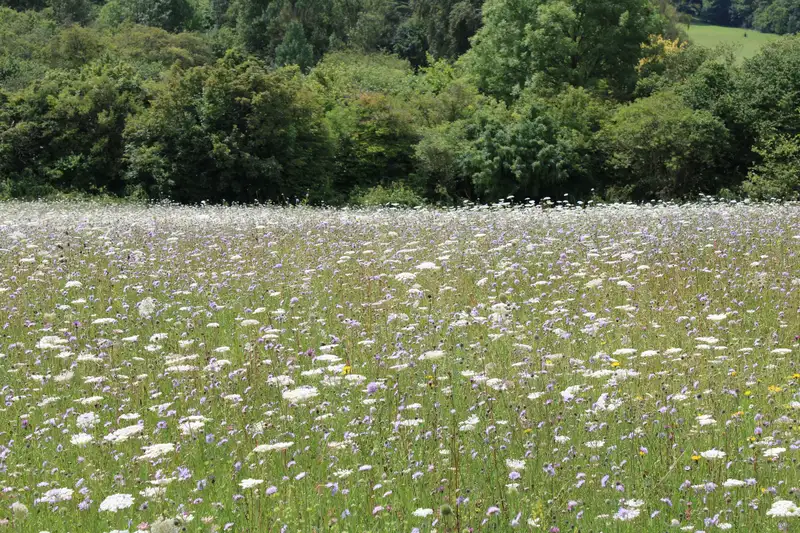
A natural burial ground, also called a green burial ground, is managed as a wildlife habitat rather than a formal cemetery. Instead of rows of headstones, you might find wildflower meadow, young woodland or established trees. Most accept ashes as well as full green burials, so some families bury ashes now and reserve a grave nearby for later. For more on how these sites work, see what a green burial is. They usually ask for a biodegradable container, or for the ashes to be poured straight into the ground, and memorials tend to be simple: a small wooden or stone marker, a tree, or nothing at all.
Can you plant a memorial tree?
Some natural burial grounds and woodland sites offer a native tree as a memorial, planted on or near the ashes plot. Policies differ. Some plant a tree for every plot, some plant in a shared area, and some do not plant memorial trees at all. Ask before you commit if a tree matters to you.
What are keepsakes?
A keepsake holds a small amount of ashes. Examples include a miniature urn, a piece of jewellery or ashes set into glass. Keepsakes work well alongside other choices, so that one person can keep something close while the rest of the ashes are buried or scattered.
How do you choose?
These questions can help:
- Did the person ever say what they wanted?
- Would you like a place to visit, and how far would people need to travel?
- Do different family members want different things?
- Would you like to keep the choice open for now?
| Option | A place to visit | Permission needed | Can it be undone? |
|---|---|---|---|
| Keep at home | Yes, at home | No | Yes |
| Scatter | Not a fixed spot | Landowner | No |
| Bury in a container | Yes | Burial ground or landowner | Only with a licence in England and Wales |
| Bury loose in the ground | Yes | Burial ground or landowner | Usually not practical |
Some of these choices can be combined. Our guide to splitting ashes explains how families share ashes between people and places.
To see which sites in your area accept ashes, compare natural burial grounds near you.
Common questions
Is there a time limit for deciding what to do with ashes?
No. Once you have collected the ashes, UK law does not require you to do anything with them by a particular date. If the crematorium is still holding them, it may set a collection deadline or charge for storage, so check with them.
What do most families do with ashes?
In the SunLife Cost of Dying Report 2026, 51% of people who arranged a cremation said they scattered the ashes, 30% kept them and 18% buried them.
Can we do more than one thing with the ashes?
Yes. Many families split the ashes, for example burying most of them in one place and keeping a small amount at home or in a keepsake.
Do I need permission to bury or scatter ashes?
On land you do not own, you need the landowner's permission. On your own land you do not, but think about what would happen if you moved house.